Science + technologyEdition 01
MAGAZEEN.
For the endlessly curious
A Little More Wonder
8 perspectives. One world.2026
No. 01 / A Little More Wonder
MAGAZEEN.
For the endlessly curious
A magazine, not a feed.
Grab a corner. Find a new perspective.
MAGAZEEN.
For the endlessly curious
MAGAZEEN.
For the endlessly curious
The index Edition 01
A little surprise in the middle
Astronomy 01 / Field notes

Astronomers found 84 unusual sources by looking differently at old X-ray observations. Their biggest glow may be in light we struggle to see.
Magazeen Editors / 3 min read
Astronomy The story
Imagine listening to a song through a speaker that barely plays the bass. A whole part of the music could be hiding in plain hearing.
Astronomers faced a similar problem with light. Looking through old observations from NASA's Chandra telescope, they found 84 unusual sources across six galaxies. The objects showed up in very-low-energy X-rays, then faded in higher-energy views.
Their largest output may lie in ultraviolet light that is especially hard to observe across space. What powers them is not settled. The exciting part is the discovery of a population that a different way of looking had missed.
Sometimes a discovery needs a new telescope. Sometimes it needs a better question for an old telescope's data.
Researchers searching the public archive of NASA's Chandra X-ray Observatory found 84 unusual sources in six galaxies. The objects stood out in the lowest-energy X-ray images but largely disappeared in higher-energy ones.
The team calls them hypersoft X-ray sources. “Soft” means lower-energy X-rays. It does not mean the objects are weak or harmless.
Think back to that speaker that struggles with bass. A bass-heavy song might sound surprisingly thin through it.
This is only an analogy: telescopes collect light, not music. But how sensitive an instrument is to different energies affects what we notice.
The researchers examined the sources' X-ray spectra: how their detected light is spread across different energies. Models fitted to those measurements suggest that much of their output is actually in extreme ultraviolet light.
That ultraviolet glow is inferred, not directly measured here. Hydrogen and helium between stars readily absorb it, making it difficult to trace across space.
Did you know?
All 84 sources were found using observations already in Chandra's public archive. Looking specifically at the lowest-energy X-rays revealed objects that mostly vanished from higher-energy images. A new discovery did not require a new set of observations. Read NASA's account.
One leading idea involves dense stellar remains, such as white dwarfs, neutron stars or black holes, drawing gas from companion stars. Material heated in that process can shine brightly.
But the team has not identified every object. The new group may contain several kinds of system.
Finding out matters beyond naming the dots. Ultraviolet radiation can knock electrons off atoms in the gas between stars. Hot stars supply some of that energy, but do not explain all the relevant observations. Hidden ultraviolet-bright objects could help fill the gap.
Some sources might also be related to the white-dwarf systems that produce Type Ia supernovae. That is a possibility to investigate, not a way to predict an explosion tomorrow.
For now, the solid result is a new population with an unusual low-energy signature. The rest is a promising set of questions. An archive, it turns out, can still hold surprises.
Scientists discover mysterious new X-ray objects unlike any they have seen before
NASA's Chandra Unveils Mysterious X-ray Objects
Hypersoft X-ray sources as a low-energy class of luminous cosmic emitter
Magazeen. Original conceptual illustration with representative dots; not a survey image or to scale.. Image source
Computing infrastructure 02 / Field notes

Fast processors need fast connections, cooling and somewhere to live. Nvidia's latest forecast is really a story about the whole machine.
Magazeen Editors / 2 min read
Computing infrastructure The story
Imagine hiring brilliant cooks, then making them share one narrow doorway to the pantry. Adding more cooks will not necessarily get dinner ready sooner.
AI computers have their own version of that problem. Processors need to exchange data, receive power and get rid of heat. Nvidia increasingly sells systems that tackle those jobs together, not just chips. Its boss, Jensen Huang, is betting that demand for the whole setup will drive another huge year of growth. The machines exist. Whether the business grows as fast as he expects is a different question.
Seventy percent is a striking growth forecast for an already enormous company. According to TechCrunch, Nvidia chief executive Jensen Huang said revenue could grow that much year over year in its next fiscal year.
Put a mental label on that number: prediction, not result. To understand the pitch, look beyond the chip.
Return to our busy kitchen. The cooks represent processors. The ingredients stand for data. A slow trip to the pantry can leave good cooks waiting; a hot, crowded kitchen creates another problem altogether.
Computers are not kitchens, but the comparison gets at something real. Doing calculations is only part of the job. Moving information between processors and carrying heat away also matter.
Nvidia's GB200 NVL72 is one example. Rather than a single graphics card, it is a liquid-cooled rack connecting many processors. Its connections help the parts work together as a larger computing system.
Did you know?
The “72” in GB200 NVL72 corresponds to 72 Blackwell GPUs in one rack, alongside 36 Grace CPUs. A GPU is a processor suited to doing many calculations at once. Here, the connections between them are part of the product too.
That helps explain Nvidia's ambitions. It operates across a chain that includes equipment makers, cloud providers, data centers and AI businesses.
It does not prove the growth forecast. TechCrunch also asks about Nvidia investing in companies that buy its equipment. Huang points to customers' revenue-generating contracts as evidence of demand. That is his explanation, not a guarantee that every investment will pay off.
Other companies are developing chips, and better software could change how much computing a task needs. Results also vary by task: a performance claim for one setup is not a promise about every use.
The interesting shift is that the product is becoming a whole system. The next leap in AI computing may depend as much on helping the cooks work together as on hiring a faster cook.
Jensen Huang explains why Nvidia will grow an astounding 70% next year
Magazeen. Original conceptual illustration created for Magazeen; not a product schematic.. Image source
Quantum physics 03 / Field notes
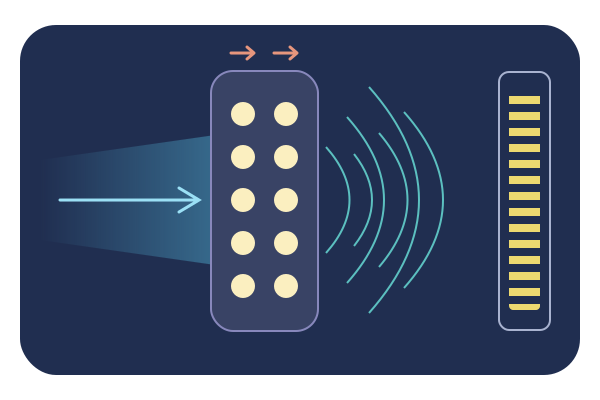
A classic experiment now fits inside a crystal. Its pattern reveals something surprising about how neighbouring atoms move together.
Magazeen Editors / 3 min read
Quantum physics The story
Drop two pebbles into a pond and watch the ripples meet. Some reinforce each other; others cancel out. A quantum experiment uses a related idea, only with electron waves instead of water.
Researchers in Japan have shrunk this familiar experiment until its two paths fit inside a silicon crystal. Better still, the pattern survives heating because neighbouring atoms can move together. That turns a beautiful quantum effect into a way to study those tiny movements. It has not produced a cooler computer chip yet. But it gives researchers a new way to look at the motions that help heat travel through a solid.
A solid crystal looks still. Zoom in far enough, though, and its atoms are moving. The interesting question is whether neighbours move together or each do their own thing.
A team at the University of Tokyo has found a way to investigate that relationship using a very small version of the double-slit experiment.
In the familiar experiment, waves travel along two paths and meet. The result is an interference pattern: bands where waves reinforce one another, separated by bands where they cancel.
Pond ripples are a useful comparison. But electron waves are not water rising and falling. They describe the chances of detecting electrons in different places.
Instead of cutting two holes in a barrier, the researchers aimed a fine electron beam across two neighbouring columns of silicon atoms. Those columns scattered the waves, producing the pattern on a detector.
The columns were just 136 picometres apart: less than a billionth of a metre. Isolating the pair mattered. Too many columns would mix their signals together and hide the local detail.
Heating makes atoms move more. You might expect all that extra motion to blur the pattern.
Yet clear bands remained. What mattered was not only how far the atoms moved, but how they moved relative to each other.
Imagine two dancers taking the same step sideways. Both change position, but the gap between them stays the same. The atoms are not following choreography; the comparison simply explains why shared movement can preserve a relationship that independent movement would disturb.
Did you know?
This experiment's “slits” were not holes. They were neighbouring columns of silicon atoms that scattered the electron beam. The resulting pattern revealed how the columns' movements were linked. Read the study.
The pattern carries information about linked vibrations and the stiffness of atomic bonds. That could help researchers understand how heat moves through materials.
This is a measuring technique, not a finished cooling technology. Using it to study defects and more complicated materials is still work ahead.
For now, the achievement is wonderfully specific: a way to see not just where atomic neighbours sit, but how they move together.
Researchers shrink double-slit experiment to atomic scale
Atomic-scale double-slit interferometry with a focused electron probe
Magazeen. Original conceptual illustration; not a research image or to scale.. Image source
Neurotechnology & design 04 / Field notes
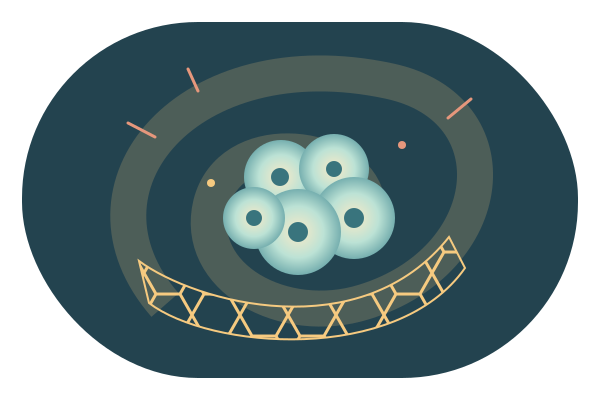
A tiny electrode sheet opens like a paper basket. Its job is to listen to living cells without getting in their way.
Magazeen Editors / 3 min read
Neurotechnology & design The story
How do you listen to brain cells without disturbing them? A stiff probe can damage soft tissue, which is bad for both the cells and the recording.
Researcher Xiao Yang is exploring a gentler approach. Her team makes extremely thin, flexible electronics. For one design, they borrowed an idea from kirigami: cutting a flat sheet so it can open into a three-dimensional shape. The result is a tiny, basket-like structure that can fit around growing cell clusters. Think of a flexible hammock rather than a rigid bench. It is a research tool, not a ready-made treatment.
Brain cells communicate through electrical activity. Researchers can pick up that activity with electrodes: tiny contacts that connect living tissue to recording equipment.
But there is a catch. A rigid probe can damage nearby tissue. Scar tissue can then make the recording less effective. The thing doing the listening gets in the way.
Xiao Yang, a researcher at Johns Hopkins University featured in MIT Technology Review's latest biotechnology coverage, is designing electronics that bend more easily.
Think about how a hammock changes shape around its occupant. A bench mostly asks you to adapt to it. That is a rough analogy for the design goal: make the instrument better able to fit living tissue, rather than forcing tissue against a rigid shape.
Yang and colleagues use a chip-making technique called photolithography to pattern very thin metal-and-polymer devices. Earlier work in mice found that flexible structures could fit closely among neurons. That does not mean they are ready to be used in people.
Another design works with organoids: small clusters of cells grown in a lab to study parts of brain biology.
The researchers cut tiny patterns into a sheet of electrodes. When opened, it forms a honeycomb-like spiral basket. A young organoid placed on it can grow into contact with the electrodes.
Did you know?
Kirigami turns paper into new shapes by cutting it. The patterned cuts in Yang's electrode sheet similarly let a flat device open into a three-dimensional basket. The device itself is not made of paper.
Her profile reports that the team has used the approach to study cells with a genetic feature linked to several brain-related disorders.
That is a way to investigate cells, not evidence of a cure. An organoid is also not a complete human brain; its activity cannot tell us everything about thought or disease.
Still, the design idea is lovely. Sometimes a better scientific instrument comes not from making something stronger, but from knowing where to let it bend.
Meet the under-35s shaping the future of biotech
Xiao Yang — Art-inspired bioelectronics
Magazeen. Original conceptual illustration created for Magazeen; not microscopy or a device reconstruction.. Image source
Planetary science 05 / Field notes
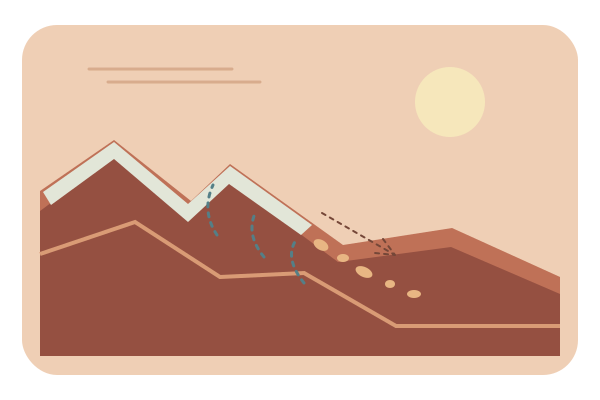
Fresh channels do not always mean flowing water. A new study of Martian slopes points instead to seasonal frost and escaping gas.
Magazeen Editors / 3 min read
Planetary science The story
A channel cuts down a dusty slope. Loose material gathers at the bottom. On Earth, you might suspect a stream. On Mars, the same shape can send you down the wrong trail.
A new preprint examines active gullies near the planet's south pole. The clues point toward carbon-dioxide frost turning into gas and helping grains move downhill, rather than running water. Timing is part of the detective work: not every icy process happens when the gullies change. This is a proposed explanation for activity at one study site, not the final answer to every channel on Mars.
A Martian slope can look as though a rainstorm has just swept through. But a shape is not a weather report.
A team led by Apolline Leclef studied active gullies at Sisyphi Cavi, near Mars's south pole. Their question was specific: what is changing these slopes today?
The team's new paper is a preprint, meaning the findings have not yet been established through peer review.
The researchers combined infrared observations from two Mars orbiters with models of seasonal ice.
They found carbon-dioxide ice. Near the end of the frost season, they did not detect a separate surface deposit of water ice that lingered behind. Detected salts also did not show a convincing link to the active gullies.
Then they checked the calendar. Dark spots associated with carbon-dioxide geysers appeared earlier in the season. The gully changes happened later, as the frost thinned and disappeared.
Think of a detective checking a suspect's timetable. A possible explanation becomes less convincing if its busiest period does not match the event. That comparison helps explain the reasoning; it does not prove the processes can never interact.
The evidence favours flows or avalanches helped along by carbon-dioxide ice turning directly into gas. That change is called sublimation. It skips the liquid stage.
Gas can help loosen and move grains on a slope. So when researchers discuss material becoming easier to flow, they do not mean the dry ice has become a liquid river.
Did you know?
Seasonal carbon-dioxide ice on Mars can let sunlight reach the ground beneath it. The warming helps ice turn directly into gas, which can build pressure below the ice. A layer of liquid water is not required. Read the researchers' explanation.
The instruments can miss ice that is buried, shaded or too thin to detect. The study also does not directly film gas pushing through grains. Its case comes from combining composition, seasonal timing and models.
And changes happening now at Sisyphi Cavi are not the same question as how every Martian gully originally formed.
The useful advance is a sharper explanation to test. These slopes may be telling a story about retreating frost, not a missing river.
What's Carving Active Gullies on Mars? It's Not Water
Magazeen. Original conceptual illustration of a proposed mechanism; not an observation or to scale.. Image source
AI & privacy 06 / Field notes

One family video. A few suggested questions. An uncomfortable reminder that collecting public details can reveal more than any single post.
Magazeen Editors / 3 min read
AI & privacy The story
You share a cheerful family video. Underneath it, an AI assistant suggests asking who your child is. That is a very different kind of curiosity.
Meta says it has changed its suggestions after a parent described just such an experience. The company says the answers used information the viewer could already access. But there is a difference between seeing a few puzzle pieces and having a tool assemble the whole picture for you. The story raises a simple design question: should an assistant help us understand a post, or encourage us to investigate the person in it?
The video was ordinary: a mother and her child singing in a car. What appeared beneath it was not.
According to The Verge, Kalie Robins said Meta AI suggested a question asking who the child was. After she selected it, she said the assistant gathered details from her earlier posts and posts by relatives. More suggested questions asked about her children's ages and where the family lived.
Meta acknowledged that those questions should not have been suggested. A spokesperson told The Verge that the problem had been fixed.
The company also said the feature's answers used information the person viewing it could already access. That matters: the report does not establish that the assistant broke through account permissions.
But imagine scattered pieces of a jigsaw. One shows a birthday. Another shows a relative. A third gives a clue about a place. Each piece may seem harmless on its own.
A tool that gathers the pieces can make the picture much easier to see. This is an analogy for combining information, not a claim that every answer in this case was correct. The key distinction is between allowing someone to see a detail and actively helping them build a profile.
Did you know?
In this case, the invasive question was suggested by the interface before the parent typed it. As The Verge reports, chatbot safety is also about which questions a product invites us to ask.
Robins also reported seeing a photograph she believed she had deleted years earlier. That is concerning, but the report does not explain how it appeared. It is not proof that Meta improperly kept a deleted image.
Nor does one account tell us how often similar suggestions appeared or whether every version of the feature now behaves as intended.
The broader lesson is straightforward. A button can steer our curiosity just as much as an answer can. A helpful assistant needs to recognize when “tell me more” has crossed from explaining a post into investigating a family.
Meta says it’s changing AI suggestions after posing invasive personal questions
Magazeen. Original conceptual illustration created for Magazeen; no personal information depicted.. Image source
Materials physics 07 / Field notes
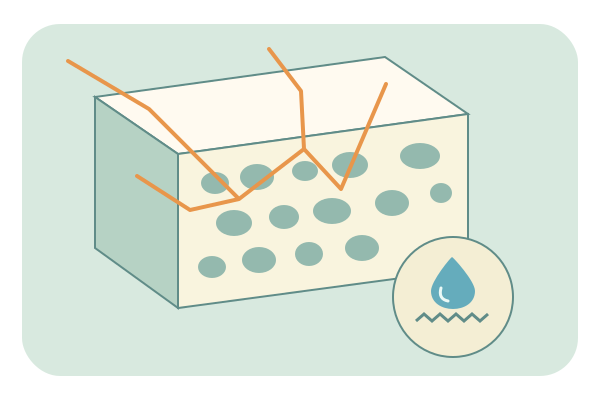
Tiny pores can make a material look white. A new process puts that idea to work in films and fibres, with a water-repelling twist.
Magazeen Editors / 3 min read
Materials physics The story
Water is not white. So why are snow and clouds?
Their tiny structures scatter light in many directions. A team led by Kyoto University has borrowed that idea for polymer films and fibres. Instead of adding a white pigment, the researchers create a fine network of pores inside the material. The structure does the optical work.
There is a second trick, too: carefully shaping the surface can make water bead up. It is a promising laboratory method, not proof of a cheaper or greener replacement for paint. The delightful idea is that changing a material's shape can change what it does.
If you wanted to make something white, reaching for a tin of paint would be a reasonable start. These researchers reached for light instead.
A team led by Kyoto University has developed a way to turn parts of a polymer into a microscopic foam. Its internal structure scatters visible light, making the material look white without adding a white pigment.
Imagine light taking many different turns as it passes through the foam. A miniature pinball table is a rough picture of the idea: lots of opportunities to change direction.
Light is not literally made of little pinballs. The useful part of the comparison is scattering. The many tiny boundaries between material and pores redirect it.
To build those pores, the team starts with a light-sensitive film. Ultraviolet light both breaks some polymer chains and links others together. A weak solvent then helps pores form and expand in the remaining network.
The researchers call the method deep-foam photolithography. In plain language, they use light to help write a pattern into a material's structure. They have demonstrated it with several polymers, including films and fibres.
Did you know?
Snow and clouds look white largely because their structures scatter light, not because water contains a white pigment. The new foam borrows that principle. Tiny internal boundaries redirect light and make it appear white. Read the explanation.
The team can also make the foam collapse in a controlled way. That produces a rough surface with strong water repellency.
The distinction matters. Pores inside the material help scatter light; texture at its surface helps control water. They are related design tools, not one magical coating that does everything.
The approach offers ways to get useful properties without adding a white pigment or a persistent fluorinated coating. But it still uses polymers, light and a solvent.
The accessible report and paper abstract do not establish its full environmental footprint, factory-scale cost or resistance to years of wear.
Those are questions for the next stage. For now, the advance is a new laboratory method with a lovely lesson: sometimes the missing ingredient is not another substance. It is a different structure.
Scientists create brilliant white material without a drop of white pigment
Foaming photopolymers as a high-resolution biomimetic printing platform
Magazeen. Original conceptual illustration; not microscopy or to scale.. Image source
AI policy & accountability 08 / Field notes

Before asking whether a machine could turn against us, researcher Timnit Gebru wants us to ask a simpler question. Who decided to use it this way?
Magazeen Editors / 2 min read
AI policy & accountability The story
Picture an AI system making a harmful decision. Who should explain what happened: the chatbot, or the people who built and used it?
In a new WIRED interview, researcher Timnit Gebru argues that talk about all-powerful future machines can push today's human choices out of the picture. She wants more attention on things we can already question: weapons, environmental costs and decisions about workers. You do not have to agree with every part of her argument to see its useful starting point. A machine can be complicated. Responsibility should not disappear inside it.
Imagine a bridge collapses. We would ask who designed it, who checked it and whether anyone ignored a warning. We would not begin by wondering whether the bridge had bad intentions.
That is the comparison AI researcher Timnit Gebru uses in a new WIRED interview. Her point is not that software works like a bridge. It is that complicated technology still comes with human responsibilities.
AI debates often race ahead to a dramatic question: could a future machine become powerful enough to threaten humanity? Gebru thinks that focus can distract from choices people are making right now.
She points to AI in weapons, the environmental pressures of computing and bosses citing AI when cutting jobs. These are issues with people and organizations attached. We can ask who approved a system, what checks it went through and who pays when it goes wrong.
Think of this as following a trail of decisions rather than searching for a machine's personality. The trail may be messy. But it gives journalists, workers and the public something concrete to examine.
Did you know?
Gebru says she collects old predictions about AI and asks people to guess their decade. The wording can sound surprisingly familiar. Her WIRED interview is a reminder to ask what is genuinely new, not just newly exciting.
There is an important limit here: this is an interview, not an experiment. It presents Gebru's argument. It does not prove that discussion of future disasters causes people to overlook present harms, or establish what every AI company secretly intends.
And we do not have to choose only one time horizon. Preparing for future risks and challenging harmful uses today can happen together.
The useful takeaway is smaller than either a promise of paradise or a prediction of doom. Before getting lost in what a machine might someday want, ask what people are choosing to do with it now. That is a question we can start answering.
One of AI’s Fiercest Critics Says All the Doom Talk Is ‘Meant to Distract Us’
Magazeen. Original conceptual illustration created for Magazeen.. Image source
Until the next edition Keep looking up
Made for curious minds, not endless feeds. Original editorial illustrations. Independent perspectives. Every story has sources, because wonder and rigour belong together.